


Talos Linux On-Prem — GitOps, Production Discipline#
kubectl apply ever touches production. Sealed secrets, wildcard TLS automation, MetalLB load balancing, middleware-enforced security headers, and a unified Prometheus/Loki/Grafana observability stack complete the picture.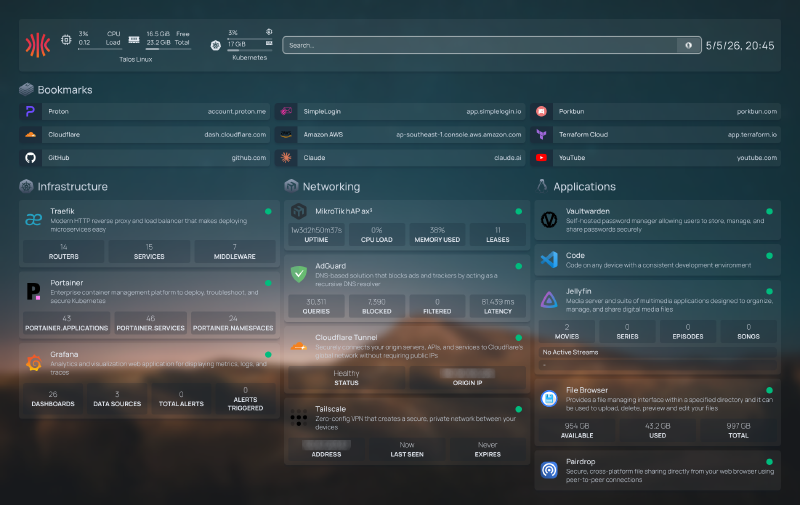
Architecture Overview#
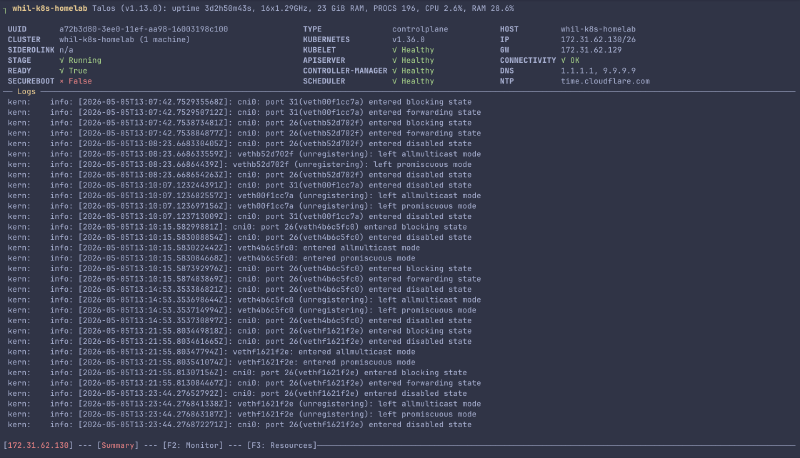
The cluster runs on bare-metal on-prem hardware provisioned declaratively with Talos Linux — an immutable, API-driven OS purpose-built for Kubernetes. Node configuration is fully codified and applied via a task runner; there is no SSH access, no shell login, and no manual OS-level state. Flux (flux-system) watches the Git repository and reconciles every manifest, Helm release, and Kustomization automatically. All service exposure is handled by Traefik as the single ingress point, with MetalLB assigning external IPs for LoadBalancer services. Cloudflare Tunnel (cloudflared) provides public reachability without opening inbound firewall ports.
| Layer | Component | Namespace |
|---|---|---|
| GitOps | Flux CD | flux-system |
| Secret encryption | sealed-secrets | kube-system |
| TLS issuance | cert-manager | cert-manager |
| TLS distribution | reflector | kube-system |
| Ingress | Traefik | traefik |
| Load balancer | MetalLB | metallb-system |
| Home dashboard | Homepage | homepage |
| DNS sink | AdGuard Home | adguard |
| Media server | Jellyfin | jellyfin |
| File sharing | Pairdrop | pairdrop |
| Password manager | Vaultwarden + PostgreSQL | vaultwarden |
| Dev environment | code-server | code-server |
| Infra dashboard | Portainer | portainer |
| Static site | Caddy | caddy |
| Public tunnel | cloudflared | cloudflared |
| Metrics | Prometheus | monitoring |
| Dashboards | Grafana | monitoring |
| Log aggregation | Loki (single-binary) | monitoring |
| Log collection | Alloy (DaemonSet) | monitoring |
| Alerting | AlertManager | monitoring |
| Security scanning | Trivy Operator | trivy-system |
| Backup/restore | VolSync | volsync-system |
Platform Breakdown#
Flux CD — Continuous Reconciliation
Flux runs in the flux-system namespace and is the operational core of the cluster. It watches the Git repository for changes and continuously reconciles the actual cluster state against the declared state. Every manifest, Helm release, and Kustomization layer is managed through Flux — not applied manually.
The reconciliation loop means configuration drift is impossible to sustain: any manual kubectl apply or in-cluster edit is overwritten on the next sync cycle.
Flux components in use:
| Controller | Role |
|---|---|
source-controller | Pulls from Git and Helm repositories, produces versioned artifacts |
kustomize-controller | Applies Kustomization stacks in dependency order |
helm-controller | Manages HelmRelease CRDs — upgrades, rollbacks, values reconciliation |
notification-controller | Emits events on reconciliation success/failure |
Repository Layout
All cluster configuration is structured so Flux’s Kustomize controller can resolve dependencies in the correct order — CRDs before controllers, controllers before workloads. SealedSecret manifests are committed alongside their consuming Deployments; plaintext secrets never appear in the repository.
Node Provisioning — Talos Linux
Talos Linux is an immutable, minimal OS with no shell, no SSH, and no package manager — all configuration is applied through a declarative machine config over a secured API. Node provisioning is fully automated via a task runner that codifies every step: generating machine configs, applying patches, and bootstrapping the cluster. Key configuration concerns (network settings, kernel parameters, kubelet flags, and cluster extras) are expressed as structured patches rather than imperative commands.
This model means the OS layer is as auditable and reproducible as the Kubernetes layer above it — any node can be re-provisioned from scratch without manual intervention.
Secret Management
Sealed Secrets runs in kube-system and handles encryption of all cluster secrets. Raw Kubernetes Secret manifests are never committed to Git — only SealedSecret CRDs encrypted with the controller’s public key. This makes the GitOps repository safe to store in version control without exposing credentials.
TLS — cert-manager
cert-manager issues a single wildcard certificate via Cloudflare DNS-01 challenge. The resulting secret is automatically mirrored by reflector into every service namespace declared in the Certificate’s annotations.
All IngressRoute and Ingress resources reference the same TLS secret — no manual secret copying, no per-namespace certificate requests.
Ingress — Traefik
Traefik runs in the traefik namespace and is the single ingress controller for all services. Middleware definitions (security headers, rate limiting, IP allowlisting) are declared in a ConfigMap mounted as a file provider inside the Traefik pod and referenced in annotations.
Load Balancer — MetalLB
MetalLB runs in the metallb-system namespace and assigns external IPs to LoadBalancer-type services. This enables services like AdGuard Home to receive a stable, LAN-reachable IP without relying on NodePort or host networking.
Public Tunnel — cloudflared
cloudflared in the cloudflared namespace creates an outbound-only Cloudflare Tunnel with two replicas for high availability. Public services route through this tunnel — no inbound firewall rules required, no exposed NodePorts. Internal-only services remain behind the IP allowlist middleware and are never reachable externally.
PVC Backup — VolSync
VolSync runs in the volsync-system namespace and handles asynchronous replication of PersistentVolumeClaim data off-cluster. Each stateful workload declares a ReplicationSource CRD that schedules periodic snapshots and pushes them to an external destination. A corresponding ReplicationDestination CRD allows point-in-time restore by pulling a named snapshot back into a fresh PVC.
DNS — AdGuard Home
AdGuard Home (adguard namespace) serves as the local DNS resolver and ad/tracker sink for the LAN. It receives a dedicated external IP via MetalLB and listens on port 53, making it the network-wide DNS server. Upstream resolvers are configured for encrypted DNS-over-HTTPS.
Media — Jellyfin
Jellyfin (jellyfin namespace) is the self-hosted media server. Accessible internally via Traefik IngressRoute with the wildcard TLS cert.
File Sharing — Pairdrop
Pairdrop (pairdrop namespace) provides local wireless file transfers — a self-hosted alternative to AirDrop that works across platforms on the same network.
Password Manager — Vaultwarden + PostgreSQL
Vaultwarden runs in the vaultwarden namespace backed by a PostgreSQL instance in the same namespace. Provides a self-hosted Bitwarden-compatible password manager. Data is persistent via a PersistentVolumeClaim; PostgreSQL credentials are managed through sealed-secrets. SMTP is handled via an external mail relay.
Dev Environment — code-server
code-server (code-server namespace) exposes VS Code as a web application. Uses a relaxed CSP/frame policy via a dedicated Traefik middleware to allow the VS Code web UI to function correctly.
Home Dashboard — Homepage
Homepage (homepage namespace) serves as the service launcher — a configurable start page with widgets for each self-hosted service and a live Kubernetes cluster widget showing pod/node status.
Infra Dashboard — Portainer
Portainer (portainer namespace) provides a visual interface for cluster and container lifecycle management, running in Kubernetes mode.
Static Site — Caddy
Caddy (caddy namespace) serves the static site using raw manifests only, with content synced from a local build. Sits behind Traefik for TLS termination and routing.
Security Scanning — Trivy Operator
Trivy Operator runs in the trivy-system namespace and provides continuous in-cluster scanning across four domains:
| Scan type | What it covers |
|---|---|
| Vulnerability | Container image CVEs against upstream advisory DBs |
| Config audit | Kubernetes manifest misconfigurations (e.g. privileged containers, missing resource limits) |
| RBAC assessment | Overly permissive roles and bindings across namespaces |
| Secret scanning | Hardcoded credentials and tokens in workload specs |
Results are surfaced as Kubernetes CRDs (VulnerabilityReport, ConfigAuditReport, RbacAssessmentReport, ExposedSecretReport) and exposed as Prometheus metrics — scraped by the existing Prometheus instance in monitoring and visible in Grafana.
Traefik Middleware Chain
Middlewares are defined in a ConfigMap mounted as a file provider inside the Traefik pod and referenced in IngressRoute annotations.
| Middleware | Purpose |
|---|---|
secure-headers | HSTS, frameDeny, nosniff, referrer-policy |
code-server-headers | Relaxed CSP/frame policy for VS Code web UI |
rate-limit | Request rate limiting with burst tolerance |
ip-allowlist | LAN + cluster CIDR only |
All internal services apply the IP allowlist — requests from outside the LAN or cluster CIDR are rejected at the ingress layer before reaching any application. Public services exposed through cloudflared bypass the allowlist via a dedicated IngressRoute entry.
Secret Lifecycle
All secrets follow this flow:
- Generate or retrieve credential
- Encrypt with
kubesealusing the controller’s public key - Commit
SealedSecretmanifest to Git - Flux detects the commit and syncs; controller decrypts and creates the
Secretin-cluster
No plaintext secrets in Git. No manual kubectl create secret commands. Every secret change has a Git commit as its audit trail.
TLS Flow
cert-manager (DNS-01 via Cloudflare API)
  └─ issues: wildcard TLS secret (in cert-manager ns)
       └─ reflector mirrors → all service namespaces
            └─ IngressRoute references mirrored TLS secret
cert-manager handles automatic renewal. reflector handles propagation. Services reference the secret by name — zero manual intervention on cert rotation.
Metrics — Prometheus
Prometheus (monitoring namespace) scrapes metrics from all cluster workloads and the underlying nodes. Configured with multiple replicas and extended retention. Service monitors are declared as ServiceMonitor CRDs co-located with their target deployments. Trivy Operator security scan results are also exposed as Prometheus metrics, making security posture visible alongside infrastructure health.
Dashboards — Grafana
Grafana (monitoring namespace) provides dashboards for both metrics (Prometheus datasource) and logs (Loki datasource pre-configured). Accessible internally via Traefik.
Log Aggregation — Loki
Loki runs in single-binary mode in the monitoring namespace — appropriate for single-node homelab scale without the operational overhead of microservices mode. Configured with short retention suitable for local-path storage.
Log Collection — Alloy
Grafana Alloy runs as a DaemonSet in the monitoring namespace, collecting logs from all pods across the cluster and forwarding them to Loki. Alloy replaces the deprecated promtail. Configuration is declared as a ConfigMap and managed in Git.
Alerting — AlertManager
AlertManager (monitoring namespace) handles alert routing from Prometheus with multiple replicas for reliability. Alert rules are defined as PrometheusRule CRDs and version-controlled alongside the rest of the cluster configuration. Routing is configured for Slack with separate channels for critical and warning severity.
The full observability pipeline: Alloy → Loki for logs, Prometheus → AlertManager for metric-based alerts, Grafana for unified visibility.
Lessons Applied#
These principles emerged from running this cluster under real conditions:
- GitOps is the only sane operational model — Flux makes drift impossible and every change auditable. Without it, cluster state diverges from documentation faster than documentation gets updated.
- Immutable OS, immutable cluster — Talos Linux eliminates an entire category of undocumented state. There is no shell to log into and make a one-off change that never makes it back to Git.
- Namespace isolation is not optional — one misconfigured deployment should not be able to reach secrets in another namespace.
- Automate TLS end-to-end or suffer cert rot — cert-manager + reflector eliminates an entire class of silent failures.
- Seal secrets before they touch Git — retrofitting secret hygiene is painful and leaves audit trail gaps.
- Single ingress controller, one middleware source of truth — proliferating ingress patterns create inconsistent security postures.
- Build the observability stack first — deploying Prometheus and Loki before services means every deployment is observable from day one.
- File providers for Traefik middleware — avoids CRD sprawl and keeps middleware definitions reviewable in a single ConfigMap.
- MetalLB unlocks clean service exposure — assigning stable external IPs to LoadBalancer services (especially DNS) avoids NodePort hacks and keeps routing predictable.
Closing Thoughts#
This cluster is a GitOps-first engineering platform built on Talos Linux. The OS is declarative. Flux is the enforcer: the Git repository is the cluster. Every secret is sealed, every service terminates TLS from the same wildcard cert, and every log line flows to Loki.
The discipline isn’t complexity for its own sake — it’s what makes a single-node homelab operationally honest: no undocumented state, no forgotten manual changes, no certificates expiring unnoticed. If it isn’t in Git, it doesn’t run.